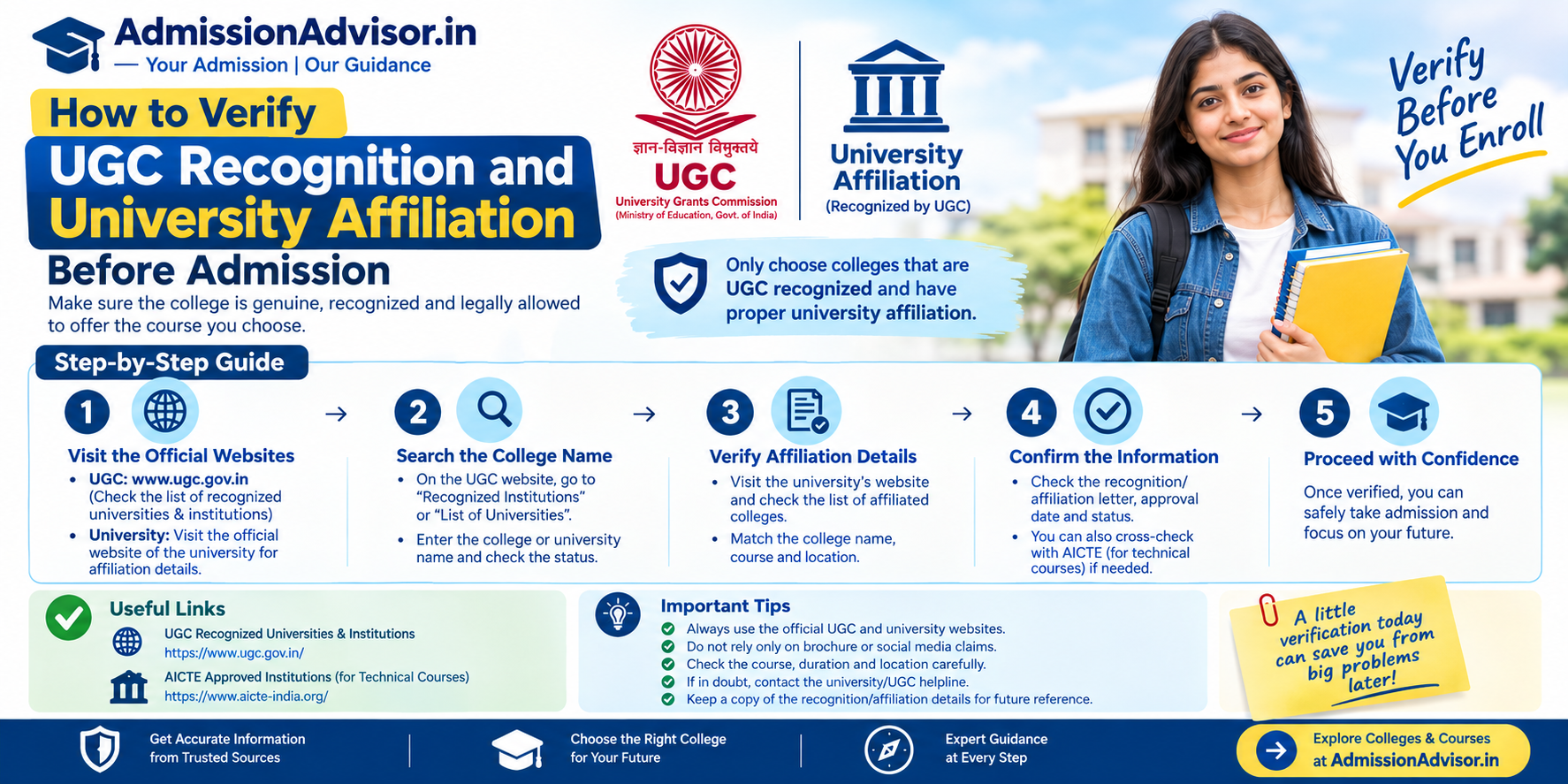
Choosing a college is an important decision. Before paying an admission fee, students should verify whether the institution is legally recognized and whether the course they want to study is being offered through the appropriate university or regulatory framework.
A college website, brochure, advertisement, or social-media post should not be the only source of verification. The safest approach is to check the institution and its affiliation through official government or university websites.
This guide explains how students can verify UGC recognition, university affiliation, and relevant approvals before taking admission.
The University Grants Commission (UGC) is a statutory organization established under an Act of Parliament in 1956. It is responsible for coordination and maintenance of standards in university education.
UGC maintains official information about recognized higher-education institutions. Its website currently provides separate information for different categories of universities, including:
Students should check the official UGC records rather than relying only on information provided by a college.
This is an important point that students often misunderstand.
A university and an affiliated college have different roles.
The university may be the degree-awarding institution, while a college may be affiliated with that university and conduct the programme according to the applicable rules.
UGC maintains a separate database of colleges under Section 2(f) and Section 12(B) of the UGC Act, 1956. The UGC college database includes information such as the college name, affiliated university, address, status and year of establishment.
Therefore, when checking a college, students should ask two separate questions:
Do not treat a college's claim of "UGC approved" as a substitute for checking the actual university and affiliation details.
Before checking recognition, note the college's exact official name.
Check:
This is important because colleges can have similar names.
For example, do not search only for:
ABC College
Instead, verify the complete name, location and affiliating university.
Visit the official UGC website and use its Higher Education Institutions/Universities information.
UGC — University Grants Commission
UGC provides university details by category and lists information such as the university's name, address, state and status.
Look for the exact university name claimed by the college.
If the college says it is affiliated to a particular university but the information cannot be matched with official records, stop and investigate further before paying fees.
If the institution is an affiliated college, check the official website of the university.
Look for sections such as:
Then confirm:
College name + location + course/programme
match the university's official information.
UGC publishes regulations concerning affiliation of colleges by universities, including regulations on colleges offering technical education.
Do not stop after finding the college name.
A college may offer several programmes, and the student should verify the specific course.
For example, if you are applying for:
check that the course is actually offered through the institution and university for the relevant academic session.
The university/college website should provide the current programme information, and where another regulator is involved, that regulator's records should also be checked.
UGC recognition is only one part of verification.
Depending on the programme, students may also need to check the relevant regulatory or statutory body.
For example, technical education programmes may involve AICTE requirements. AICTE's official systems provide institute-related information and approval-related records.
Therefore, for a technical programme, check both:
University/UGC status
and
relevant AICTE approval/status, where applicable.
Do not assume that one approval automatically proves every other approval.
Recognition and programme permissions can be session-specific in some areas.
This is particularly important for online and distance education.
UGC specifically states that students must verify recognition for the academic session in which they are taking admission; recognition for an earlier session does not automatically establish recognition for the next session.
So before admission, check:
Is the institution/course recognized or permitted for my admission session?
Do not rely on an old approval letter alone.
Students choosing online or distance education should perform an additional check.
UGC provides year-wise recognition information for institutions and approved programmes for Open and Distance Learning (ODL) and online education. UGC advises students to check the recognition status for the specific session before admission.
For these programmes, verify:
A university being recognized for regular education does not mean that every online or distance programme is automatically recognized for every session.
UGC also maintains an official List of Fake Universities.
The UGC page currently identifies the list as being as of February 2026 and provides information on institutions identified as fake universities.
Before taking admission, students can check whether the institution appears on the official list.
UGC — List of Fake Universities
This should be treated as an additional verification step, not the only check.
A college may advertise statements such as:
"UGC Approved"
"Government Recognized"
"AICTE Approved"
"University Affiliated"
These statements should be independently verified.
Students should ask the college for:
Then compare those details with official sources.
College website ? useful for information
Official regulator/university website ? use for verification
After verifying the institution, save screenshots or PDF copies of important official information.
Keep records of:
This can be useful if there is a disagreement later regarding the course or institution.
| Term | What students should understand |
|---|---|
| UGC recognition/status | Relates to the university/institution's status under the applicable UGC framework |
| University affiliation | Shows the relationship between an affiliated college and its university |
| AICTE approval | Relevant to programmes/institutions falling within AICTE's regulatory scope |
| Accreditation | A separate quality-assessment concept and should not be confused with recognition |
| Ranking | A ranking position is not the same as legal recognition or affiliation |
A college can have a good ranking or strong placement claims, but students should still independently verify recognition and affiliation.
Before paying the admission fee, ask the college:
Google search results can help you find information, but they are not the official authority for recognition.
Always check whether the information applies to your current admission session.
A university's recognition does not automatically answer whether a particular college is affiliated to it for the course you want.
Use the official university and regulatory websites for independent verification.
Different programmes can have different regulatory requirements. Check the relevant authority for your specific course.
Before paying your admission fee, complete this checklist:
? Exact college name verified
? University name verified
? University checked on official UGC website
? College affiliation checked on university website
? Exact course/programme verified
? Relevant regulatory approval checked where applicable
? Current academic session checked
? Online/ODL recognition checked where applicable
? UGC fake-university list checked
? Official documents/screenshots saved
Choosing a college should involve more than comparing fees, rankings and placement packages.
Before admission, verify who awards the degree, which university the college is affiliated with, whether the specific programme is properly covered, and whether the relevant recognition or approval applies to your admission session.
UGC itself provides official information that students can use to verify higher-education institutions, while its databases also provide information on universities and colleges.
The safest approach is simple: Check ? Verify ? Compare ? Then Apply.
For students researching colleges, courses, fees, admissions and other college information, AdmissionAdvisor.in can be used as a starting point for comparison—but official university and regulator sources should be used to independently verify recognition and approval information.
How To Verify UGC Recognition And University Affiliation Before Admission
22 September, 2026 By: AdmissionAdvisor Editorial TeamCloud Computing Career After B.Tech: Skills, Jobs & Scope In 2026–27
19 September, 2026 By: AdmissionAdvisor Editorial TeamWhich Course Is Better After 12th Commerce? A Complete Career Guide For Students
19 September, 2026 By: AdmissionAdvisor Editorial TeamFirst-Year College Guide 2026: 16 Things Every New Student Should Know Before Starting College
17 September, 2026 By: AdmissionAdvisor Editorial TeamBCA Vs B.Tech CSE: Which Is Better For A Software Career?
15 September, 2026 By: AdmissionAdvisor Editorial TeamNo Internship = No Job? How Important Are Internships Really?
13 September, 2026 By: AdmissionAdvisor Editorial TeamTop 20 Engineering Colleges In India : Ranking, Courses, Admission & How To Choose The Best College
11 September, 2026 By: AdmissionAdvisor Editorial TeamIs College Ranking More Important Than Placement?
9 September, 2026 By: AdmissionAdvisor Editorial TeamCollege Ranking Vs Placement Vs ROI: Which One Should Students Trust?
7 September, 2026 By: AdmissionAdvisor Editorial TeamWhat Should I Check Before Taking MBA Admission
7 September, 2026 By: AdmissionAdvisor Editorial TeamCan BCA Students Get Software Jobs? A Complete Career Guide
6 September, 2026 By: AdmissionAdvisor Editorial TeamHow To Verify Whether A College Is Genuine Before Admission In India
6 September, 2026 By: AdmissionAdvisor Editorial TeamCollege Placement Vs Fees: Is Your College Really Worth It?
6 September, 2026 By: AdmissionAdvisor Editorial TeamB.Tech Vs BCA Vs BBA: Which Course Is Right For You?
4 September, 2026 By: AdmissionAdvisor Editorial TeamSkills Vs College Brand In 2026: What Do Companies Really Prefer?
2 September, 2026 By: AdmissionAdvisor Editorial Team