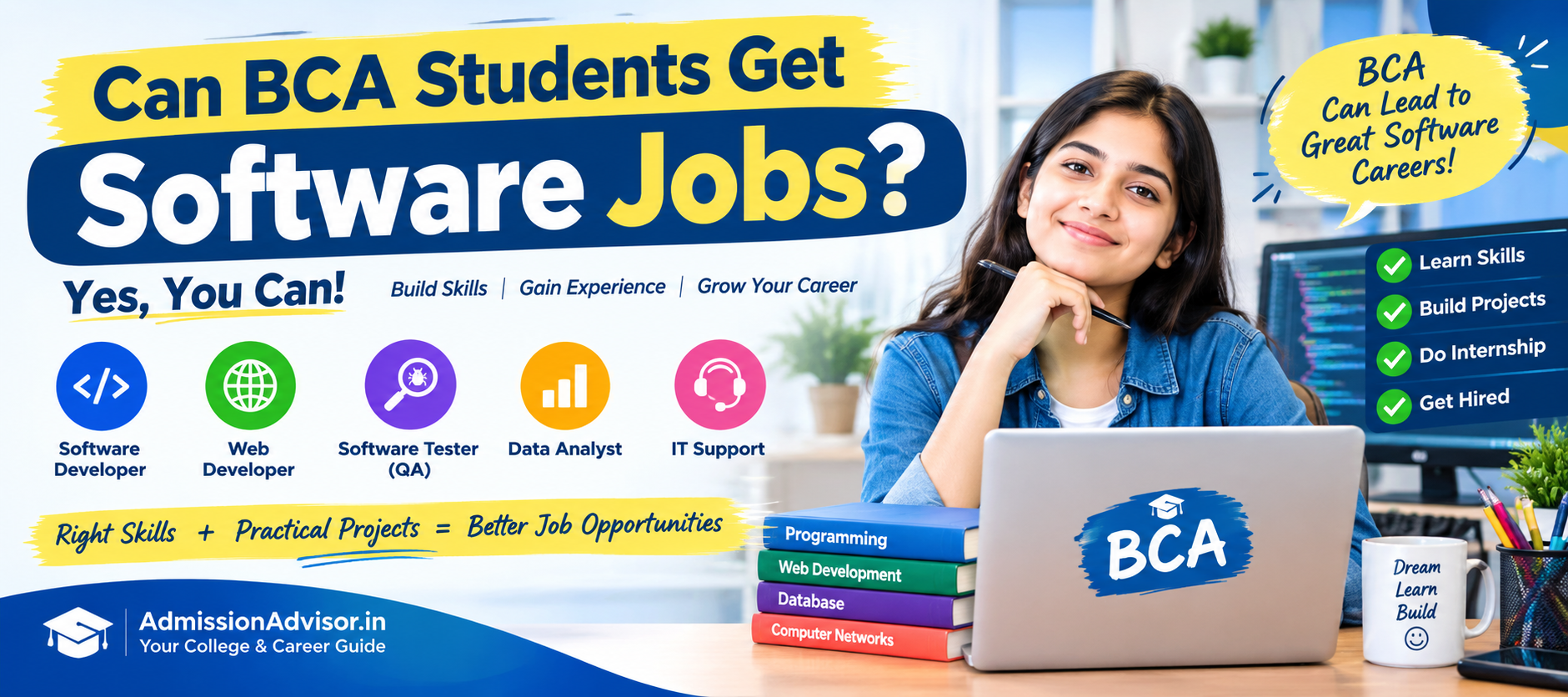
Yes, BCA students can definitely get software jobs. A Bachelor of Computer Applications (BCA) provides students with a foundation in programming, databases, web development, computer networks and software concepts.
However, simply completing a BCA degree does not guarantee a software job. Skills, projects, internships, communication and practical experience can make a major difference.
For students planning their career after Class 12, BCA can be a good option—especially for those interested in computers and software but who may not want to pursue a four-year B.Tech degree.
BCA graduates can apply for various entry-level technology roles, depending on their skills.
A software developer creates and maintains applications and software.
Useful skills:
Web developers build and maintain websites and web applications.
Students can start with:
Frontend:
HTML + CSS + JavaScript + React
Backend:
Node.js / Python / Java / PHP
Students interested in finding software bugs can explore software testing.
Important areas include:
BCA students with an interest in data can develop skills in:
These skills can help them move toward entry-level data-related roles.
IT support can be another starting point for BCA graduates.
The role may involve:
Yes, but the degree alone is usually not enough.
Think of it this way:
BCA Degree + Technical Skills + Projects + Internship + Communication = Better Job Opportunities
A student with a BCA degree and strong practical skills may be more employable than a student who has only completed the syllabus and has no practical experience.
Students should avoid trying to learn everything at once.
Choose one career direction and build skills around it.
Learn:
Programming ? DSA ? Database ? Git ? Projects
Learn:
HTML ? CSS ? JavaScript ? React ? Backend ? Projects
Learn:
Excel ? SQL ? Python ? Power BI ? Projects
Learn:
Manual Testing ? SQL ? API Testing ? Automation
A common mistake among students is completing courses without building anything.
Instead, create practical projects.
A project gives students something concrete to discuss during interviews.
Yes. BCA graduates can apply for suitable entry-level technology positions when they meet the company's eligibility and skill requirements.
However, eligibility varies from company to company.
Some employers may accept:
BCA / B.Sc CS / B.Tech / MCA
while others may specifically require a particular degree.
Therefore, students should always check the eligibility criteria in the actual job description.
MCA can be a useful next step, but it is not compulsory for everyone.
Consider MCA if you:
On the other hand, a BCA graduate who already has strong skills, projects and experience may choose to enter the workforce directly.
Path 1:
BCA ? Skills ? Internship ? Software Job
Path 2:
BCA ? MCA ? Skills ? Software Job
Path 3:
BCA ? Job ? Experience ? Career Growth
There is no single correct path for every student.
Salary depends on many factors, including:
Students should not choose BCA only because of a promised salary package.
Instead, focus on building skills that employers actually need.
You don't need to learn 10 languages.
Academic marks are important, but practical skills matter too.
Build projects and put them on your resume.
Software professionals need to communicate with teammates, clients and managers.
Start learning practical skills from the first year.
Focus on:
Focus on:
Focus on:
Choose between:
Job | MCA | Internship ? Job | Specialised Certification
Both courses can lead toward software careers, but they are different programmes.
| Factor | BCA | B.Tech CSE |
|---|---|---|
| Duration | Usually 3 years | Usually 4 years |
| Focus | Computer applications | Engineering + computer science |
| Programming | Yes | Yes |
| Software career | Possible | Possible |
| Higher study option | MCA | M.Tech/MS/MBA etc. |
| Practical skills | Important | Important |
The better choice depends on the student's academic background, career goals, budget and preferred learning path.
Absolutely, yes.
But students should remember:
A BCA degree opens the door; your skills help you walk through it.
Start learning practical technology skills early, build real projects, complete internships where possible, improve communication and prepare seriously for interviews.
For students who enjoy coding, computers and problem-solving, BCA can be a practical starting point for a career in the IT and software industry.
Is College Ranking More Important Than Placement?
9 September, 2026 By: AdmissionCollege Ranking Vs Placement Vs ROI: Which One Should Students Trust?
7 September, 2026 By: AdmissionWhat Should I Check Before Taking MBA Admission
7 September, 2026 By: AdmissionCan BCA Students Get Software Jobs? A Complete Career Guide
6 September, 2026 By: AdmissionHow To Verify Whether A College Is Genuine Before Admission In India
6 September, 2026 By: AdmissionCollege Placement Vs Fees: Is Your College Really Worth It?
6 September, 2026 By: AdmissionB.Tech Vs BCA Vs BBA: Which Course Is Right For You?
4 September, 2026 By: AdmissionSkills Vs College Brand In 2026: What Do Companies Really Prefer?
2 September, 2026 By: AdmissionWhat To Do After A Low JEE Main Percentile
2 September, 2026 By: AdmissionScholarships For College Students: What You Should Check Before Applying
1 September, 2026 By: AdmissionHow To Calculate The Real Cost Of A College Education In India
31 August, 2026 By: AdmissionOff-Campus Vs Campus Placement: Which Path Gives Better Opportunities?
30 August, 2026 By: AdmissionHow AI Is Changing Engineering Jobs: Which B.Tech Branch Should You Choose?
29 August, 2026 By: AdmissionNEET College Choice Strategy 2026: Government Vs Private Medical College ROI
28 August, 2026 By: AdmissionB.Tech CSE Vs AI/ML Vs Data Science Vs IT: 2026–2030 Career & Salary Comparison
28 August, 2026 By: Admission