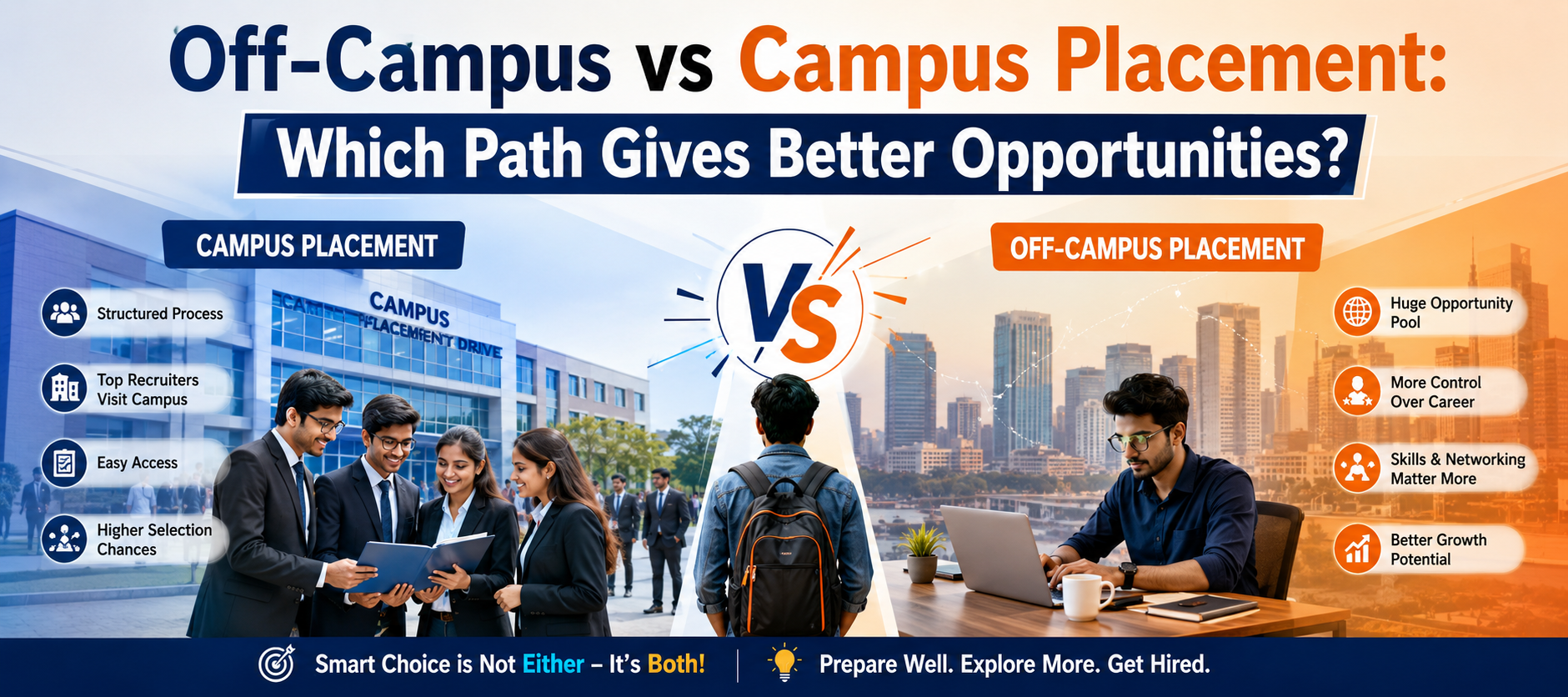
For many college students, getting a good job is the ultimate goal of graduation. But one important question often creates confusion: Should you depend on campus placements, or should you actively search for off-campus opportunities?
The reality is that neither path is automatically better. Your college, skills, academic performance, communication ability, internships, projects, networking, and job market all influence the outcome.
In this guide, we compare campus placement vs off-campus placement so students can understand the differences and choose the right strategy for their career.
Campus placement is a recruitment process where companies visit a college or university to hire students directly.
Typically, the college's placement cell coordinates:
The major advantage is convenience. Students don't usually have to search for every company individually.
Off-campus placement means applying for jobs independently rather than through your college's placement process.
Students can find opportunities through:
Off-campus hiring can give students access to companies that may not visit their college campus.
| Factor | Campus Placement | Off-Campus Placement |
|---|---|---|
| Job Search | College-supported | Student-driven |
| Competition | Usually among eligible students | Potentially nationwide/global |
| Company Access | Companies visiting campus | Much wider company pool |
| Networking | Moderate | Very important |
| Application Process | Relatively structured | Requires continuous applications |
| Resume Importance | Important | Extremely important |
| Referrals | Helpful | Often highly valuable |
| Preparation | Placement-oriented | Company-specific |
| Convenience | Higher | Lower |
| Opportunity Range | Depends on college | Potentially much wider |
Campus placements bring recruiters directly to the institution. Students don't need to identify every company themselves.
The process is generally organized by the placement department, making it easier for students to understand the recruitment stages.
Students can participate in multiple recruitment drives without spending significant time searching for openings independently.
Students with limited professional experience can benefit from campus recruitment because companies specifically recruit fresh graduates.
Students studying at well-known institutions may have access to recruiters that regularly hire from their campus.
Campus placement also has limitations.
The biggest limitation is opportunity dependency.
If a particular company does not visit your college, you generally cannot apply through that campus drive.
Other limitations may include:
Therefore, having campus placement facilities does not guarantee a good job.
Off-campus applications allow students to target companies beyond their college's recruiter network.
A student can potentially apply to:
Instead of accepting whichever companies visit campus, students can target specific roles and industries.
For example, a B.Tech CSE student interested in:
AI ? Machine Learning ? Data Science ? Software Engineering
can search specifically for those roles.
For many technical roles, strong skills, projects, internships, problem-solving ability, and interview performance can help students compete beyond their college network.
Off-campus recruitment can expose students to roles and companies that may not participate in their college placement program.
Off-campus hiring isn't limited to the final year. Students can search for internships, freelance projects, part-time opportunities, and full-time positions throughout their education and after graduation.
Off-campus recruitment requires significantly more initiative.
Students may have to send dozens or even hundreds of applications before receiving interview opportunities.
Common challenges include:
Therefore, off-campus placement requires patience, consistency, networking, and strong employability skills.
The answer depends on the student.
For most students, the best approach isn't campus OR off-campus.
It is:
Campus + Off-Campus = More Opportunities
Don't stop applying off-campus simply because your college has a placement program.
Similarly, don't ignore campus recruitment because you believe off-campus companies offer better opportunities.
Use campus placements as your first opportunity channel and off-campus recruitment as your second opportunity channel.
Keep your resume focused on:
Avoid filling your resume with unnecessary information.
For technical students, useful areas can include:
Programming ? DSA ? Git/GitHub ? SQL ? Projects ? System fundamentals ? Interview preparation
For management students:
Communication ? Excel ? Business analytics ? Presentation ? Internships ? Domain knowledge
A practical project can demonstrate your ability better than simply listing a technology on your resume.
For example, instead of writing:
"Knowledge of Python"
show:
"Developed a Python-based data analysis project using real-world datasets."
Your LinkedIn profile should clearly communicate:
Who you are + what you can do + what role you want.
Use it for networking, following recruiters, discovering jobs, and connecting with alumni.
Employee referrals can be valuable in off-campus recruitment.
Connect professionally with:
Don't simply ask strangers for a job. Build a professional connection first.
Focus on:
Start applying regularly to:
Focus on:
Campus placement provides convenience and structured access. Off-campus placement provides flexibility and a much broader opportunity pool.
The strongest students don't depend entirely on either one.
They build skills, prepare for interviews, participate in campus drives, and simultaneously explore off-campus opportunities
Is College Ranking More Important Than Placement?
9 September, 2026 By: AdmissionCollege Ranking Vs Placement Vs ROI: Which One Should Students Trust?
7 September, 2026 By: AdmissionWhat Should I Check Before Taking MBA Admission
7 September, 2026 By: AdmissionCan BCA Students Get Software Jobs? A Complete Career Guide
6 September, 2026 By: AdmissionHow To Verify Whether A College Is Genuine Before Admission In India
6 September, 2026 By: AdmissionCollege Placement Vs Fees: Is Your College Really Worth It?
6 September, 2026 By: AdmissionB.Tech Vs BCA Vs BBA: Which Course Is Right For You?
4 September, 2026 By: AdmissionSkills Vs College Brand In 2026: What Do Companies Really Prefer?
2 September, 2026 By: AdmissionWhat To Do After A Low JEE Main Percentile
2 September, 2026 By: AdmissionScholarships For College Students: What You Should Check Before Applying
1 September, 2026 By: AdmissionHow To Calculate The Real Cost Of A College Education In India
31 August, 2026 By: AdmissionOff-Campus Vs Campus Placement: Which Path Gives Better Opportunities?
30 August, 2026 By: AdmissionHow AI Is Changing Engineering Jobs: Which B.Tech Branch Should You Choose?
29 August, 2026 By: AdmissionNEET College Choice Strategy 2026: Government Vs Private Medical College ROI
28 August, 2026 By: AdmissionB.Tech CSE Vs AI/ML Vs Data Science Vs IT: 2026–2030 Career & Salary Comparison
28 August, 2026 By: Admission