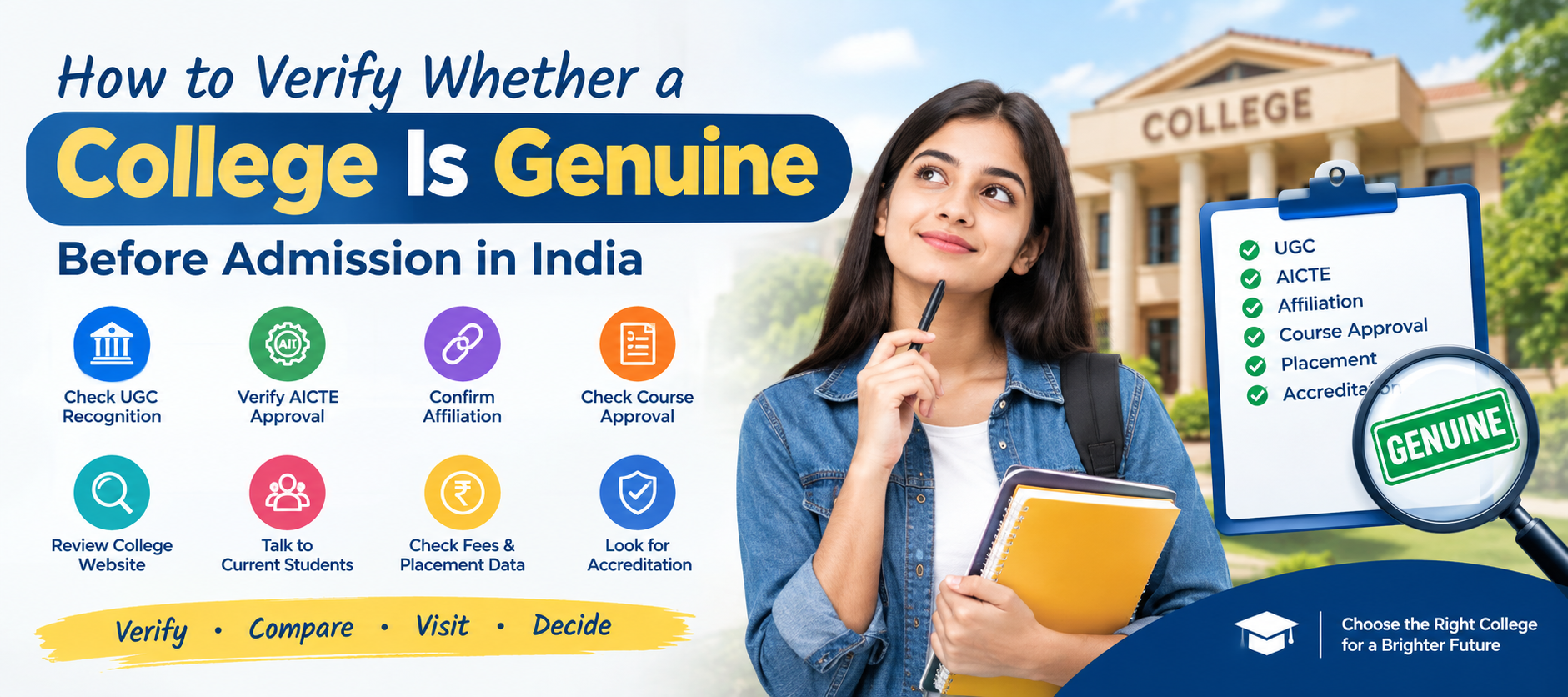
Choosing a college is one of the biggest decisions students and parents make after Class 12 or graduation. Attractive advertisements, impressive websites, placement claims and social media posts can sometimes make a college look better than it actually is.
Before paying an application fee or admission fee, students should verify whether the college is genuine, recognised and authorised to offer the course.
This guide explains a practical way to check a college before taking admission.
First, identify which university awards the degree.
If the college is affiliated with a university, verify that the affiliation is genuine and valid for the relevant academic session.
For universities in India, students should check the official information available through the University Grants Commission (UGC).
Do not rely only on a college website saying:
"UGC Approved"
Look for the institution in the relevant official UGC information.
For courses such as B.Tech, MBA, MCA and other technical/management programmes, students should check the applicable regulatory requirements and approvals.
For technical institutions, verify the institution/course information through the All India Council for Technical Education (AICTE) where applicable.
A college may advertise a course, but that does not automatically mean that the course has all the required approvals or recognition.
Always verify the exact course, institution and academic year.
A college may be:
Find out exactly who awards your final degree.
For example:
College ? University ? Degree
Students should verify that this relationship is officially documented.
A genuine college does not necessarily mean that every course offered by it is automatically recognised.
This is one of the most important checks.
Before admission, verify:
For example, don't simply check whether a college is genuine. Check whether "B.Tech CSE at this particular campus" is officially offered.
A professional-looking website is not proof that a college is genuine.
Check whether the website provides:
Also check whether important information is consistent across the website.
Be careful if you see:
"100% Placement" sounds impressive, but students should ask:
100% of how many students?
Check:
A ?20 lakh highest package does not mean every student receives ?20 lakh.
What is the median or typical placement outcome for students in my course?
Before paying money, request a complete fee structure.
Check:
Avoid making large payments based only on verbal promises.
Always keep:
Application form + fee receipt + admission letter + official communication
A physical campus visit can reveal a lot.
Look at:
If you cannot visit personally, ask the college for a live virtual campus tour and independently verify the location.
One of the best ways to understand a college is to speak with students currently studying there.
Ask them:
Don't depend on one review. Compare feedback from several students.
Search the college name along with different keywords:
"[College Name] reviews"
"[College Name] placement"
"[College Name] affiliation"
"[College Name] approval"
"[College Name] complaints"
Look for patterns rather than one extremely positive or negative review.
Be especially careful with messages such as:
"Admission guaranteed."
"No eligibility required."
"Pay today to confirm your seat."
"100% placement guaranteed."
"Direct admission available—limited seats."
"Government approved" without providing verifiable details.
A genuine admission process should provide clear documentation and official communication.
Whenever possible, pay fees through the official college/university payment system or bank account.
Be cautious if someone asks you to transfer a large amount to:
Always ask for an official receipt.
Accreditation and recognition are not the same thing.
Depending on the institution and programme, students may encounter bodies such as:
Understand what each recognition/accreditation actually means before using it to judge a college.
For example, NBA accreditation generally relates to specific programmes, so don't assume that accreditation of one programme means every programme at the college has the same accreditation.
Social media can help you understand campus activities, but it should not be your primary verification source.
Check:
Then compare those claims with information from official and regulatory sources.
Sometimes misleading organisations use names that sound similar to well-known universities or colleges.
For example, a student may search for a famous institution but accidentally contact a different organisation with a similar name.
Before applying, compare:
Exact name + official website + address + university + campus + course
Before taking admission, ask these 10 questions:
| Check | Question |
|---|---|
| 1 | Who awards my degree? |
| 2 | Is the university officially recognised? |
| 3 | Is the college properly affiliated/authorised? |
| 4 | Is my exact course recognised/approved where required? |
| 5 | Is the campus address genuine? |
| 6 | Can the college provide an official fee structure? |
| 7 | Can placement claims be independently verified? |
| 8 | Can I speak with current students? |
| 9 | Will I receive an official fee receipt? |
| 10 | Can I verify the information through official sources? |
Never choose a college only because of an advertisement, ranking, social-media post or placement package.
Before admission, follow this simple formula:
A genuine college should be able to clearly explain who recognises it, who awards the degree, what course you are joining, what you will pay and what academic/placement opportunities are actually available.
Is College Ranking More Important Than Placement?
9 September, 2026 By: AdmissionCollege Ranking Vs Placement Vs ROI: Which One Should Students Trust?
7 September, 2026 By: AdmissionWhat Should I Check Before Taking MBA Admission
7 September, 2026 By: AdmissionCan BCA Students Get Software Jobs? A Complete Career Guide
6 September, 2026 By: AdmissionHow To Verify Whether A College Is Genuine Before Admission In India
6 September, 2026 By: AdmissionCollege Placement Vs Fees: Is Your College Really Worth It?
6 September, 2026 By: AdmissionB.Tech Vs BCA Vs BBA: Which Course Is Right For You?
4 September, 2026 By: AdmissionSkills Vs College Brand In 2026: What Do Companies Really Prefer?
2 September, 2026 By: AdmissionWhat To Do After A Low JEE Main Percentile
2 September, 2026 By: AdmissionScholarships For College Students: What You Should Check Before Applying
1 September, 2026 By: AdmissionHow To Calculate The Real Cost Of A College Education In India
31 August, 2026 By: AdmissionOff-Campus Vs Campus Placement: Which Path Gives Better Opportunities?
30 August, 2026 By: AdmissionHow AI Is Changing Engineering Jobs: Which B.Tech Branch Should You Choose?
29 August, 2026 By: AdmissionNEET College Choice Strategy 2026: Government Vs Private Medical College ROI
28 August, 2026 By: AdmissionB.Tech CSE Vs AI/ML Vs Data Science Vs IT: 2026–2030 Career & Salary Comparison
28 August, 2026 By: Admission