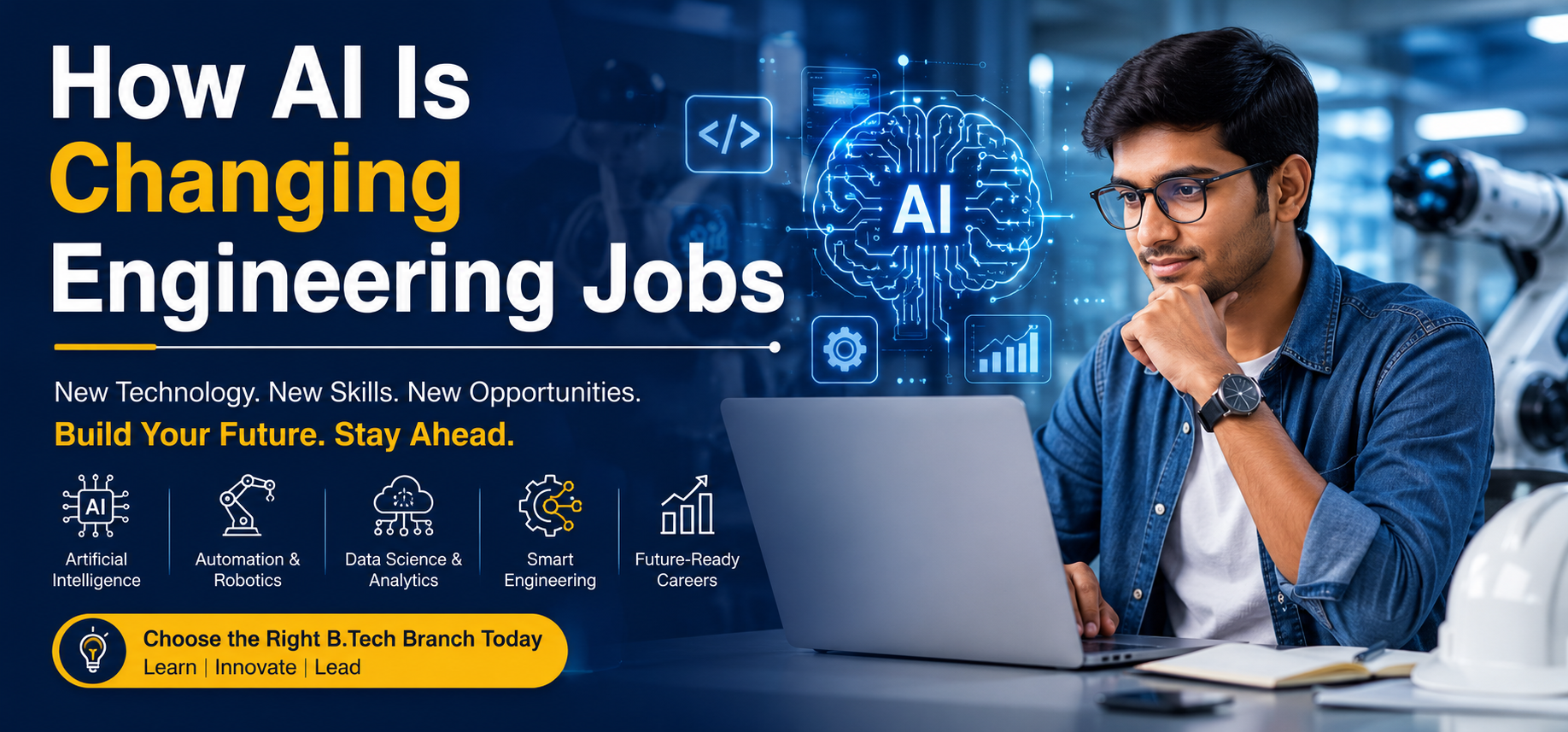
Artificial Intelligence is no longer limited to technology companies. It is rapidly becoming a part of engineering, manufacturing, healthcare, finance, automobiles, construction, electronics, energy and many other industries.
According to the World Economic Forum's Future of Jobs Report 2025, AI and information-processing technologies are expected to be among the most significant forces transforming businesses through 2030. AI and big data, networks and cybersecurity, and technological literacy are also among the fastest-growing skill areas.
For students completing Class 12 and planning to pursue B.Tech, this creates an important question:
Which engineering branch should you choose in the age of AI?
The answer is not simply "choose AI." The right B.Tech branch depends on your interests, strengths and the type of engineering career you want to build.
One of the biggest misconceptions about AI is that it will replace all engineering jobs.
In reality, AI is more likely to automate repetitive tasks and increase the productivity of engineers, while creating demand for professionals who can combine engineering knowledge with AI tools.
For example, a software engineer may use AI to generate code, test applications and identify bugs. A mechanical engineer may use AI for predictive maintenance and product optimisation. An electronics engineer may work with robotics, embedded systems and intelligent devices.
The World Economic Forum expects a combination of technical and human capabilities—including analytical thinking, creative thinking, resilience and collaboration—to remain important alongside AI-related skills.
There is no single "best B.Tech branch" for every student. However, some branches are particularly well positioned to benefit from AI-driven technological growth.
Best suited for: Students interested in software, programming, technology and problem-solving.
Computer Science Engineering remains one of the most versatile choices for students who want to work in software development, cloud computing, cybersecurity, data engineering, AI and emerging digital technologies.
AI is also changing software development itself. Engineers increasingly need to understand how to work effectively with AI coding tools rather than relying only on traditional programming methods.
Career possibilities include:
The WEF identifies software and applications developers among the technology-related roles expected to grow, while AI, big data and cybersecurity skills are increasingly important.
CSE + AI skills = one of the most flexible combinations for the digital economy.
Best suited for: Students who enjoy mathematics, programming, statistics, data and intelligent systems.
A B.Tech specialization in Artificial Intelligence and Machine Learning provides focused exposure to areas such as machine learning, deep learning, data science, computer vision and natural-language technologies.
AI and Machine Learning Specialists are among the job categories highlighted by the WEF as having strong growth potential.
However, students should remember that a degree title alone does not guarantee an AI career. Strong mathematics, programming, projects and practical experience matter enormously.
If you genuinely enjoy AI, mathematics and coding, AI/ML can be a highly focused B.Tech pathway.
Best suited for: Students interested in electronics, hardware, communication systems and emerging technologies.
AI needs hardware to operate. Chips, sensors, embedded systems, communication networks and computing infrastructure are fundamental to modern intelligent systems.
This makes ECE particularly relevant to areas such as:
The WEF's industry outlook also points to AI, robotics and energy technologies influencing electronics-related industries, with demand expected for AI/ML specialists and electrotechnology engineers.
ECE + AI + embedded systems can create opportunities at the intersection of software and hardware.
Best suited for: Students interested in power systems, electronics, automation and energy technologies.
AI is increasingly being used in energy management, smart grids, industrial automation, predictive maintenance and intelligent control systems.
The future of engineering is not only about software. AI-powered infrastructure also requires engineers who understand electricity, control systems and physical equipment.
The WEF expects energy technologies and the green transition to contribute significantly to labour-market transformation, including demand for renewable-energy and environmental engineering capabilities.
Electrical Engineering becomes more powerful when combined with automation, data analytics and AI-based control systems.
Best suited for: Students passionate about machines, manufacturing, automobiles, robotics and product design.
AI does not make mechanical engineering irrelevant. Instead, it is helping transform traditional mechanical engineering into smart engineering.
AI can support:
Modern manufacturing is increasingly combining mechanical systems with sensors, software, robotics and AI.
Mechanical Engineering + Robotics + AI + Automation can create a powerful interdisciplinary career path.
Best suited for: Students interested in construction, infrastructure, architecture, transportation and urban development.
AI is also entering the construction and infrastructure sectors through applications such as:
Civil engineers who understand digital tools, data and AI can potentially differentiate themselves from professionals relying solely on traditional methods.
The future civil engineer may be a combination of civil engineer + data user + digital technology professional.
| B.Tech Branch | AI Relevance | Suitable For |
|---|---|---|
| CSE | ????? | Coding, software & technology |
| AI & ML | ????? | AI, data & machine learning |
| ECE | ???? | Electronics, chips & robotics |
| Electrical | ???? | Energy, automation & control |
| Mechanical | ???? | Robotics, manufacturing & automobiles |
| Civil | ??? | Infrastructure & smart construction |
Important: These ratings are a broad career-oriented view, not a guarantee of employment. Your skills, projects, internships, college environment and ability to adapt can be more important than the branch name alone.
Choosing the branch is only the beginning.
Students entering engineering today should think beyond their syllabus.
1. AI Literacy
Understand what AI can and cannot do.
2. Programming
For many technology-oriented careers, Python, C++, Java or other relevant programming languages can be valuable.
3. Data Skills
Learn how to collect, analyse and interpret data.
4. Problem Solving
AI tools can generate answers, but engineers must know whether those answers are correct.
5. Communication
Engineering ideas must be explained to teams, clients and stakeholders.
6. Practical Experience
Projects, internships, competitions and industry exposure can help convert academic knowledge into employable skills.
7. Lifelong Learning
Technology changes quickly. The ability to learn new tools may become more valuable than knowing one tool permanently.
The WEF reports that employers expect nearly 40% of job skills to change by 2030, reinforcing the importance of continuous upskilling.
AI can become an engineering co-pilot.
Instead of spending hours on repetitive tasks, engineers can increasingly use AI to:
But engineers still need to provide judgement, context, creativity and responsibility.
That distinction is important.
It may belong to engineers who know how to work effectively with AI.
There is no universal answer.
You enjoy coding, software and solving logical problems.
You are particularly interested in artificial intelligence, mathematics, data and machine learning.
You enjoy electronics, hardware, communication and robotics.
You are interested in energy, automation, power systems and intelligent control.
You love machines, manufacturing, automobiles and robotics.
You want to build infrastructure and are interested in construction, smart cities and digital engineering.
The question "Which B.Tech branch is best for the future?" should be replaced with a better question:
"Which engineering branch matches my interests, while giving me opportunities to develop future-ready skills?"
AI is changing the engineering profession, but engineering fundamentals are not becoming irrelevant. Instead, engineers are increasingly expected to combine domain expertise + technology + AI + human problem-solving.
For students choosing a B.Tech branch, the smartest strategy is therefore not to chase a popular course blindly. Choose a field you can genuinely understand and enjoy, then build AI, data, digital and communication skills around it.
The engineer of tomorrow will not simply know engineering. The engineer of tomorrow will know how to use technology to solve real-world problems.
Is College Ranking More Important Than Placement?
9 September, 2026 By: AdmissionCollege Ranking Vs Placement Vs ROI: Which One Should Students Trust?
7 September, 2026 By: AdmissionWhat Should I Check Before Taking MBA Admission
7 September, 2026 By: AdmissionCan BCA Students Get Software Jobs? A Complete Career Guide
6 September, 2026 By: AdmissionHow To Verify Whether A College Is Genuine Before Admission In India
6 September, 2026 By: AdmissionCollege Placement Vs Fees: Is Your College Really Worth It?
6 September, 2026 By: AdmissionB.Tech Vs BCA Vs BBA: Which Course Is Right For You?
4 September, 2026 By: AdmissionSkills Vs College Brand In 2026: What Do Companies Really Prefer?
2 September, 2026 By: AdmissionWhat To Do After A Low JEE Main Percentile
2 September, 2026 By: AdmissionScholarships For College Students: What You Should Check Before Applying
1 September, 2026 By: AdmissionHow To Calculate The Real Cost Of A College Education In India
31 August, 2026 By: AdmissionOff-Campus Vs Campus Placement: Which Path Gives Better Opportunities?
30 August, 2026 By: AdmissionHow AI Is Changing Engineering Jobs: Which B.Tech Branch Should You Choose?
29 August, 2026 By: AdmissionNEET College Choice Strategy 2026: Government Vs Private Medical College ROI
28 August, 2026 By: AdmissionB.Tech CSE Vs AI/ML Vs Data Science Vs IT: 2026–2030 Career & Salary Comparison
28 August, 2026 By: Admission