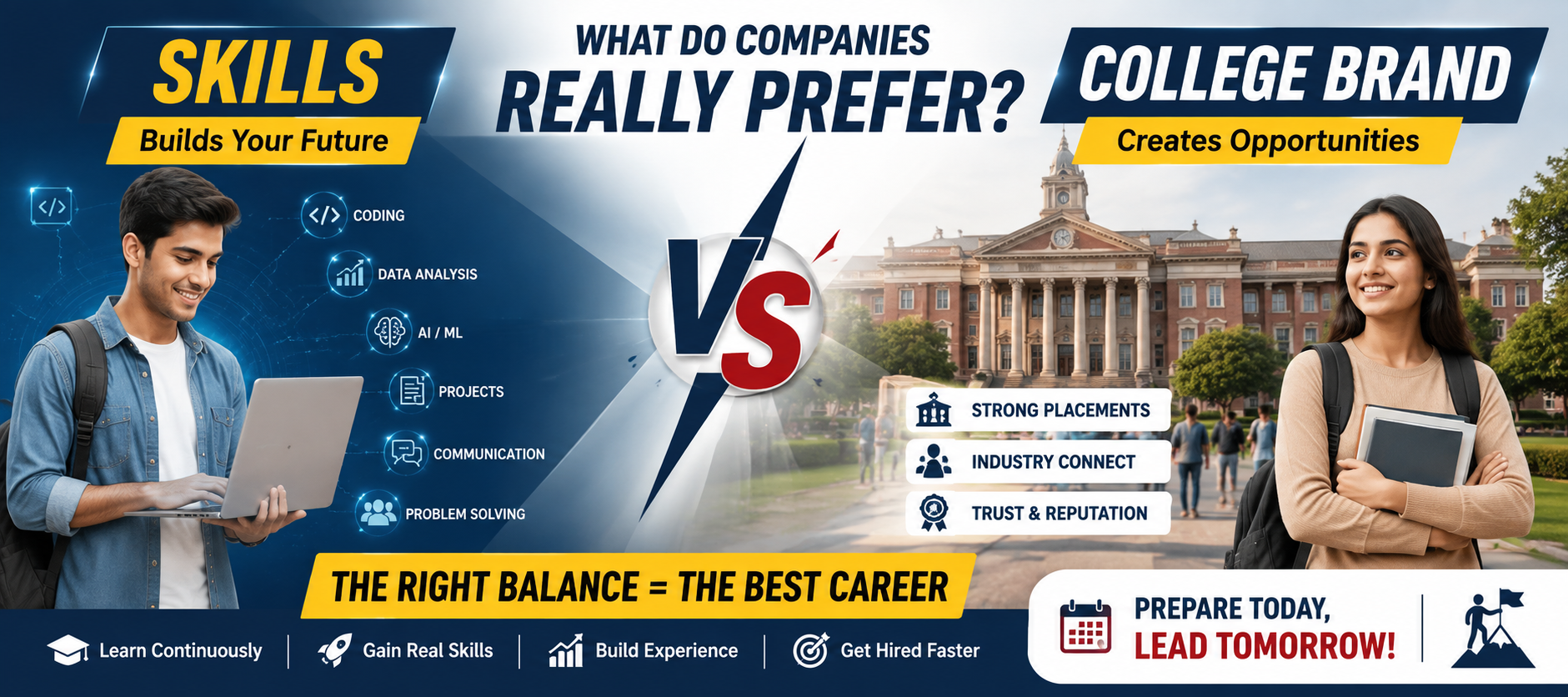
For years, students and parents have believed that a reputed college automatically means a better career. While college reputation still matters, the hiring market in 2026 is sending a more important message: a college name may help you get noticed, but your skills can determine whether you get selected.
This does not mean that college brand has become irrelevant. Instead, recruitment is increasingly becoming a combination of college reputation, academic performance, relevant skills, internships, projects, communication ability and adaptability.
Recent Deloitte India research shows that India's campus hiring environment is becoming more skills-focused. It reports that 86% of organisations say AI or agentic AI is transforming recruitment, while AI and data skills can attract hiring premiums of around 20–25%.
So, what should students focus on when choosing a college in 2026?
Yes—but it is only one part of the equation.
A well-known college can provide:
For some companies, college reputation and academic cut-offs continue to influence the initial shortlist.
According to HirePro's 2026 research, only 21% of corporates surveyed had fully adopted skills-first hiring, while many companies still consider factors such as CGPA and college background.
Therefore, saying “college doesn't matter anymore” would be misleading.
The better statement is:
College can open the door, but skills help you walk through it.
The recruitment process is changing. Companies increasingly want students who can demonstrate what they can do, rather than simply list subjects they studied.
For engineering and technology students, technical skills remain extremely important.
Depending on the career path, students may learn:
Students should avoid trying to learn everything. It is better to become genuinely good at a few skills related to the desired career.
Artificial intelligence is changing not only technology jobs but also recruitment itself.
Deloitte India reports that 35% of organisations said AI adoption is creating new entry-level roles or skill requirements, compared with 21% in FY25. It also found that AI and data capabilities are receiving significant skill premiums.
For students, this means AI literacy can become an important career advantage.
For example:
CSE student ? Python + AI/ML + GitHub + projects
Data Science student ? Python + SQL + statistics + Power BI + ML
BBA student ? Excel + analytics + digital marketing + AI tools
MBA student ? Excel + Power BI + business analytics + AI productivity tools
The goal is not simply to write “AI” on a resume. Students should be able to demonstrate how they have used technology to solve a problem.
Imagine two students applying for the same software job.
Who will be stronger?
Student B can become the stronger candidate if the company evaluates demonstrated ability.
Projects give recruiters evidence that a student can convert knowledge into practical work.
Students can build:
One of the biggest changes in campus recruitment is the increasing importance of internships.
Deloitte India reported that internship-to-offer conversions improved year-on-year, reinforcing internships as an important route to full-time employment.
An internship can help students understand:
Therefore, students should not wait until the final semester to think about work experience.
Technical knowledge alone is not enough.
A student may have excellent technical skills but struggle during an interview because they cannot clearly explain:
Companies increasingly value human capabilities such as learning agility, adaptability and collaboration, alongside technical expertise.
Students should therefore work on:
Communication + Presentation + Teamwork + Problem Solving + Confidence
The answer depends on the stage of recruitment.
| Factor | Importance |
|---|---|
| College reputation | High for initial opportunities |
| Academic performance | Important for many campus shortlists |
| Technical skills | Very high |
| AI & digital skills | Increasingly important |
| Projects | Very important |
| Internship | Very important |
| Communication | Very important |
| Problem-solving | Very important |
| Adaptability | Increasingly important |
| Networking | Useful for opportunities |
So, the real competition is not “college vs skills.”
It is:
That combination creates the strongest profile.
Absolutely.
A student from a less-famous college can build a strong career through:
However, students should also understand the reality: some companies still use college tier, CGPA or other filters during recruitment. HirePro's 2026 research indicates that skills-first hiring is still a transition rather than a universal practice in India.
This is why choosing a college carefully remains important.
Instead of asking only:
“Is this college famous?”
Students should ask:
Look at placement reports, not advertisements alone.
Check whether recruiters are relevant to your desired career.
A college that encourages internships can provide an important advantage.
Look for exposure to AI, data, cloud, cybersecurity, communication and practical learning where relevant.
Check projects, hackathons, research, clubs and competitions.
Compare fees + hostel + living expenses against realistic career outcomes.
A high-fee college is not automatically a high-value college.
For today's students, a useful career formula is:
Good College + Relevant Degree + Practical Skills + Projects + Internship + Communication + Continuous Learning = Strong Employability
Students should not depend entirely on either the college brand or their skills.
A prestigious college without employable skills can become a limitation.
Similarly, excellent skills can open opportunities, but a good college can provide a stronger platform, better networks and easier access to recruiters.
The hiring market of 2026 is moving toward a more balanced model.
College brand can help you get opportunities.
Skills can help you convert opportunities into jobs.
Experience can help you build your career.
The smartest approach for students is therefore not to choose between college and skills.
Choose a college that gives you a good platform—and use your college years to build skills that companies actually need.
This is particularly important as AI changes recruitment and entry-level job requirements. Deloitte's latest India campus-hiring data shows that employers are increasingly combining institute tier, role/specialisation and demonstrable critical skills when differentiating candidates.
Yes. College reputation can influence campus access and initial shortlisting, although practical skills and experience are increasingly important.
Skills are increasingly important, but a degree remains relevant for many careers and employers. The strongest profile combines education with demonstrable skills.
Depending on their career, students should consider AI, data analytics, programming, cloud, cybersecurity, communication, problem-solving and other role-specific skills.
Yes. Strong skills, projects, internships, networking and interview preparation can help students compete for off-campus and other opportunities.
Students should compare placement quality, fees, ROI, curriculum, internships, infrastructure, location and career opportunities rather than relying only on the college name.
Suggested CTA:
Confused about choosing the right college? Compare colleges, courses, fees, placements and career opportunities before taking admission with AdmissionAdvisor.in.
Is College Ranking More Important Than Placement?
9 September, 2026 By: AdmissionCollege Ranking Vs Placement Vs ROI: Which One Should Students Trust?
7 September, 2026 By: AdmissionWhat Should I Check Before Taking MBA Admission
7 September, 2026 By: AdmissionCan BCA Students Get Software Jobs? A Complete Career Guide
6 September, 2026 By: AdmissionHow To Verify Whether A College Is Genuine Before Admission In India
6 September, 2026 By: AdmissionCollege Placement Vs Fees: Is Your College Really Worth It?
6 September, 2026 By: AdmissionB.Tech Vs BCA Vs BBA: Which Course Is Right For You?
4 September, 2026 By: AdmissionSkills Vs College Brand In 2026: What Do Companies Really Prefer?
2 September, 2026 By: AdmissionWhat To Do After A Low JEE Main Percentile
2 September, 2026 By: AdmissionScholarships For College Students: What You Should Check Before Applying
1 September, 2026 By: AdmissionHow To Calculate The Real Cost Of A College Education In India
31 August, 2026 By: AdmissionOff-Campus Vs Campus Placement: Which Path Gives Better Opportunities?
30 August, 2026 By: AdmissionHow AI Is Changing Engineering Jobs: Which B.Tech Branch Should You Choose?
29 August, 2026 By: AdmissionNEET College Choice Strategy 2026: Government Vs Private Medical College ROI
28 August, 2026 By: AdmissionB.Tech CSE Vs AI/ML Vs Data Science Vs IT: 2026–2030 Career & Salary Comparison
28 August, 2026 By: Admission