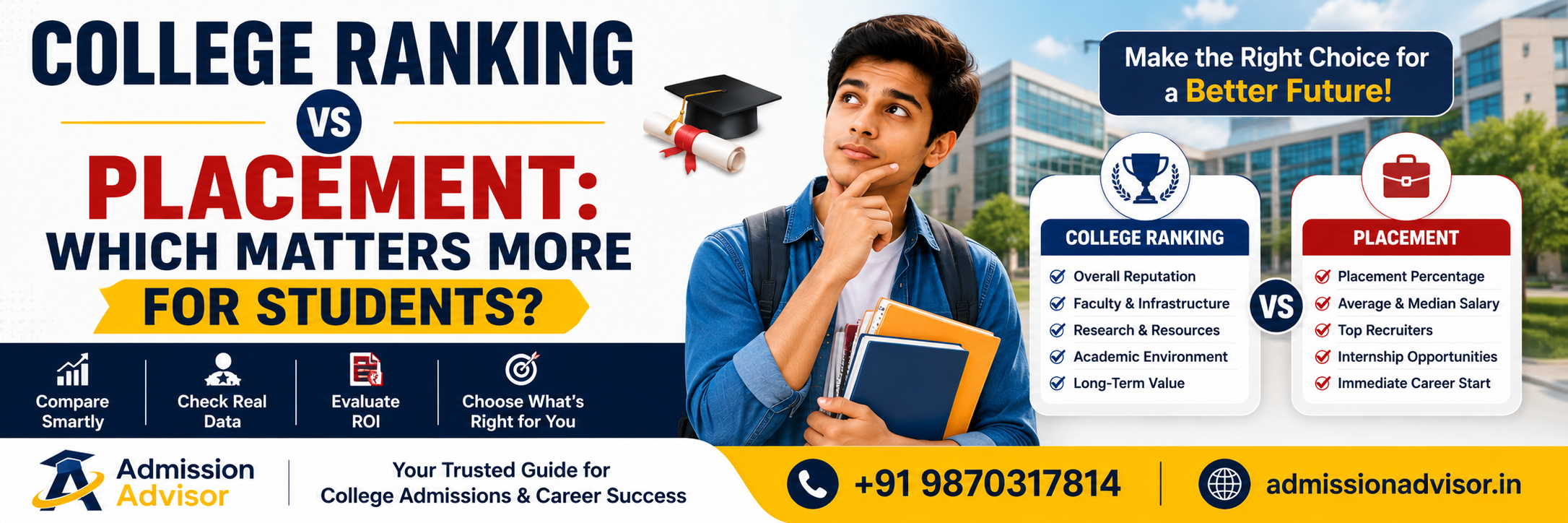
When students search for a college, two numbers often attract the most attention:
College Ranking
and
Placement Package
But which one actually matters more?
The short answer is:
Neither ranking nor placement should be considered alone. The right college decision depends on ranking + course quality + placement outcomes + fees + ROI + your career goals.
A college can have a strong overall ranking but offer different outcomes across courses. Similarly, a college may advertise an impressive highest package without that number representing the typical student outcome.
This is why students should look beyond a single number before taking admission.
| Factor | Importance for Students |
|---|---|
| Course/Branch quality | ????? |
| Placement & median salary | ????? |
| College recognition | ????? |
| Fees & ROI | ????? |
| Internship opportunities | ???? |
| Faculty & infrastructure | ???? |
| College ranking | ??? |
| Highest package | ?? |
For a career-focused student, actual course-wise placement outcomes generally deserve more attention than the college's overall ranking.
However, ranking can still be useful as one part of the decision.
College rankings attempt to evaluate institutions using multiple parameters.
For example, the NIRF Engineering ranking evaluates institutions across broad dimensions including:
The 2025 NIRF Engineering rankings show that the overall score is made up of multiple components rather than placement alone.
This is important because:
A college's ranking is an overall institutional indicator—not a guarantee of your individual salary or placement.
Placement data answers a different question:
What happened to students after completing the course?
Useful placement indicators include:
How many eligible students were placed?
What is the middle salary outcome?
What is the average reported salary?
What was the highest reported package?
Which companies actually recruited students?
How did CSE, ECE, Mechanical, MBA, etc. perform?
How many internships converted into full-time opportunities?
For example, NIRF's engineering methodology includes median salary of graduates as part of the graduation-outcomes component.
Suppose College A advertises:
Highest Package: ?40 LPA
That sounds impressive.
But suppose the actual data is:
Meanwhile College B has:
For many students, College B may actually offer the stronger typical placement outcome, despite having a lower highest package.
That's why students should not choose a college simply because its advertisement shows the biggest package.
Imagine two colleges:
NIRF Rank: 80
B.Tech CSE Median Salary: ?6 LPA
Fees: ?10 lakh
NIRF Rank: 140
B.Tech CSE Median Salary: ?8 LPA
Fees: ?6 lakh
If your primary objective is employment and ROI, College B may deserve serious consideration.
But that doesn't automatically make College B “better” overall.
College A could have advantages in:
So the correct question isn't:
“Which ranking is higher?”
It is:
“Which college is better for MY course, career objective and budget?”
One of the biggest mistakes students make is comparing colleges only at the institution level.
For example:
College A — Overall Ranking: 50
doesn't automatically mean:
College A CSE > College B CSE
You should compare the same course/branch.
Compare:
CSE vs CSE
ECE vs ECE
Mechanical vs Mechanical
rather than simply comparing the overall college rank.
ROI means Return on Investment.
Suppose:
Fees = ?12 lakh
Median salary = ?5 lakh
Fees = ?7 lakh
Median salary = ?4.8 lakh
The salary difference is relatively small, but the fee difference is significant.
Therefore, College B could provide better financial value for some students.
ROI = Career Outcome ÷ Total Education Cost
This isn't a perfect financial formula, but it is a useful way to think about college affordability.
Use this 8-point checklist:
Is your chosen course strong at the college?
Check median + average + placement percentage.
Calculate the complete cost—not just tuition.
Compare fees with realistic career outcomes.
Verify the institution and relevant programme information.
The UGC currently advises students and parents to verify the authenticity of Higher Educational Institutions before admission.
Look at industry exposure and internship opportunities.
Delhi NCR, Noida, Greater Noida, Ghaziabad, etc. can affect accessibility and industry exposure.
A student targeting research may value different factors than a student focused primarily on placements.
Placement ? Course Quality ? Fees/ROI ? Ranking
Academic Quality ? Faculty/Research ? Ranking ? Placement
Fees/ROI ? Placement ? Course Quality ? Ranking
Consider all major factors, rather than selecting based on one ranking.
Be careful if a college:
? Shows only highest package
? Does not provide recent placement data
? Doesn't explain placement percentage
? Provides only college-level data instead of branch-wise information
? Uses an old ranking as its main selling point
A ranking can also become outdated. Always check the year of the ranking and the year of the placement data.
Before paying your admission fee, check:
College website
?
Latest placement report
?
NIRF/official data where available
?
Course-wise placement information
?
Student/alumni feedback
?
Fees + ROI
?
Recognition/approval
?
This approach is much safer than relying on a single advertisement.
Students increasingly ask AI-powered search engines questions such as:
“Which is better for B.Tech CSE?”
“Is a lower-ranked college with better placement worth choosing?”
“Which college gives better ROI?”
These are comparison questions, not simple fact questions.
For that reason, a useful college article should provide:
Google says its AI search experiences continue to rely on the same fundamental principles: unique, valuable content, good page experience and pages that can be crawled and indexed.
So AdmissionAdvisor.in should avoid creating generic AI-written articles that simply repeat information found everywhere else.
Instead, add your own college comparisons, verified data and practical admission guidance.
If you are asking:
For most students who want a job after graduation:
???? Course-wise placement outcomes and realistic salary data generally matter more than the overall college ranking.
But don't ignore ranking completely.
The strongest decision is:
= ???? Better College Decision
Not necessarily. Ranking measures broader institutional factors, while placement gives information about employment outcomes. Students should consider both according to their career goals.
It depends. If the higher-ranked institution has substantially stronger academics, research, faculty or long-term opportunities, it may still be the better choice. Compare course-specific data before deciding.
Yes, but it should not be the primary decision factor. Median salary, average salary, placement percentage and the number of students placed provide more context.
NIRF is an official Ministry of Education ranking framework that evaluates institutions using multiple parameters. However, students should still use the ranking alongside course-level and placement information.
Check branch quality, placement data, median salary, fees, ROI, internships, faculty, infrastructure, recognition and location.
At Admission Advisor, we recommend that students compare colleges instead of choosing only by ranking or advertisements.
???? +91 9870317814
???? admissionadvisor.in
???? Follow Admission Advisor for practical College, Career & Admission Guidance.
CSE Vs AI/ML Vs Data Science Vs IT: Which B.Tech Branch Is Best In 2026?
23 August, 2026 By: AdmissionB.Tech Fees In India 2026: Government Vs Private Engineering Colleges
23 August, 2026 By: AdmissionBest Engineering Colleges Without JEE Main 2026: Complete Admission Guide
22 August, 2026 By: AdmissionWhich B.Tech Branch Is Best In 2026?
22 August, 2026 By: AdmissionWhat Is AdmissionAdvisor.in?
22 August, 2026 By: AdmissionCSE Vs AI/ML Vs Data Science Vs IT: Which B.Tech Branch Is Better In 2026?
21 August, 2026 By: AdmissionCollege Ranking Vs Placement: Which Matters More For Students?
19 August, 2026 By: AdmissionHow To Verify Whether A College’s Placement Claims Are Genuine
19 August, 2026 By: AdmissionHow To Score 95+ Percentile In JEE Main
18 August, 2026 By: AdmissionBest MBA Colleges In Delhi NCR 2026
17 August, 2026 By: AdmissionTop Colleges With Highest Placement Packages In India 2026
17 August, 2026 By: AdmissionAjay Kumar Garg Engineering College (AKGEC) Ghaziabad
17 August, 2026 By: AdmissionSDGI Global University Ghaziabad
16 August, 2026 By: AdmissionTop Private Engineering Colleges In India 2026
16 August, 2026 By: AdmissionCAT 2026 Preparation Strategy For Beginners: Complete Step-by-Step Guide
16 August, 2026 By: Admission