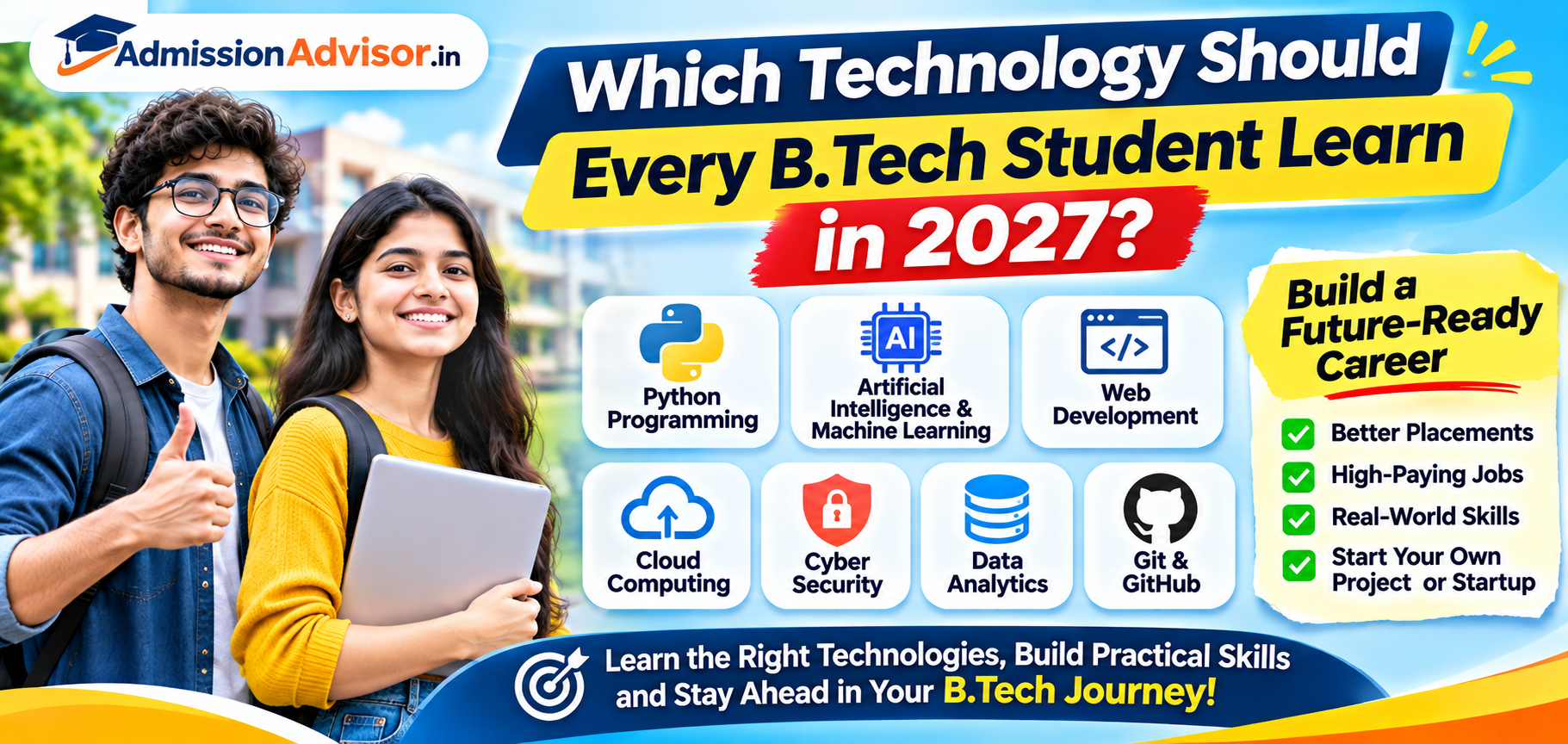
Technology is changing rapidly, and a B.Tech degree alone may not be enough to prepare students for today's competitive job market. Companies increasingly look for graduates who can apply their engineering knowledge, work with modern tools, solve real-world problems, and learn new technologies.
But an important question comes to every engineering student: Which technology should I learn during my B.Tech to build a successful career?
Should you learn Artificial Intelligence, Python, Cloud Computing, Cyber Security, Data Science, or Web Development?
The answer is simple: Do not try to learn everything at once. First, build strong technical fundamentals and then select one specialization according to your interests.
Python is one of the most useful programming languages for beginners. Its simple syntax makes it easier to understand programming concepts and develop practical projects.
Why should students learn Python?
Useful for Artificial Intelligence and Machine Learning.
Helps in data analysis and automation.
Supports web development and software development.
Has a large collection of libraries and learning resources.
Career opportunities: Python Developer, Data Analyst, Automation Engineer and Junior AI/ML Developer.
Student project idea: Build a student attendance management system or a simple data analysis application.
Artificial Intelligence (AI) is becoming an important part of software, healthcare, banking, education, manufacturing and many other industries.
Machine Learning (ML) is a branch of AI that enables computers to learn patterns from data and make predictions.
According to the World Economic Forum's Future of Jobs Report 2025, AI and big data are among the fastest-growing skills expected to become increasingly important by 2030.
Why should students learn AI and ML?
Understand how intelligent applications work.
Develop prediction and recommendation systems.
Work with data and automation.
Explore emerging technology careers.
Career opportunities: AI Engineer, Machine Learning Engineer, Data Scientist and AI Application Developer.
Student project idea: Develop a simple student performance prediction system using Python and machine learning.
Web development is a practical skill that helps students understand how websites and online applications work.
Students can begin with HTML, CSS and JavaScript, then learn a frontend framework and backend programming.
Important technologies to learn:
HTML and CSS
JavaScript
React
PHP, Python or Node.js
MySQL or PostgreSQL
Career opportunities: Frontend Developer, Backend Developer, Full-Stack Developer and Web Application Developer.
Student project idea: Create a college website, online examination portal or student placement management system.
Today, many organizations use cloud platforms to store data, host applications and manage computing resources.
Cloud computing allows businesses to use technology infrastructure without maintaining every server themselves.
Students can explore platforms such as Amazon Web Services (AWS), Microsoft Azure and Google Cloud.
Why learn cloud computing?
Understand how websites and applications are hosted.
Learn cloud storage and computing.
Explore application deployment.
Understand basic infrastructure and security.
Career opportunities: Cloud Engineer, Cloud Support Associate, DevOps Engineer and Cloud Administrator.
Student project idea: Deploy a portfolio website or a small web application on a cloud platform.
As businesses and individuals depend more on digital services, protecting information and computer systems is increasingly important.
Cyber Security focuses on identifying security risks, preventing attacks and protecting networks, applications and data.
Important topics to learn:
Networking fundamentals
Linux basics
Computer and application security
Ethical hacking fundamentals
Security monitoring
Career opportunities: Security Analyst, SOC Analyst, Network Security Engineer and Cyber Security Specialist.
Student project idea: Build a basic password-strength checker or a secure login demonstration.
Always practice security testing only in systems and environments where you have permission.
Data is used by businesses to understand customers, improve services and make better decisions.
Data Analytics teaches students how to collect, clean, analyze and present information.
Important tools to learn:
Excel
SQL
Python
Power BI
Tableau
Career opportunities: Data Analyst, Business Analyst, Reporting Analyst and Junior Data Engineer.
Student project idea: Analyze college placement data and create a dashboard showing placement percentages, average packages and branch-wise results.
Many students learn programming but do not understand how professional developers manage their code.
Git is a version-control system that helps developers track changes in their projects. GitHub provides a platform to store and collaborate on code repositories.
Why should every student learn Git and GitHub?
Maintain project versions.
Work with other developers.
Share coding projects.
Build a public technical portfolio.
Demonstrate practical skills to recruiters.
Student task: Upload at least three well-documented projects to GitHub during your B.Tech course.
You do not need to master every technology. Choose a specialization that connects with your engineering background.
| B.Tech Branch | Recommended Technologies |
|---|---|
| Computer Science (CSE) | Python, Java, DSA, AI/ML, Cloud |
| Information Technology (IT) | Web Development, SQL, Cloud, Cyber Security |
| AI & Machine Learning | Python, Statistics, ML, Deep Learning |
| Data Science | Python, SQL, Statistics, Power BI |
| Electronics (ECE) | Embedded Systems, C/C++, IoT, VLSI |
| Electrical Engineering | MATLAB, Python, PLC, Power Systems |
| Mechanical Engineering | CAD, SolidWorks, MATLAB, Robotics |
| Civil Engineering | AutoCAD, Revit, BIM, GIS |
Students should not wait until their final year to start learning practical skills.
First Year – Build Your Foundation
Learn one programming language.
Understand basic computer concepts.
Practice logical thinking and problem-solving.
Create small programming projects.
Second Year – Explore Technologies
Learn databases and GitHub.
Explore web development, AI, cloud or cybersecurity.
Select one area of interest.
Build two practical projects.
Third Year – Develop Specialization
Learn advanced concepts in your chosen technology.
Work on real-world projects.
Participate in internships and hackathons.
Improve communication and teamwork skills.
Fourth Year – Prepare for Your Career
Complete a strong final-year project.
Build a professional resume and GitHub portfolio.
Practice technical interviews.
Apply for internships and placement opportunities.
The World Economic Forum's Future of Jobs Report 2025 identifies AI and big data, networks and cybersecurity, and technological literacy among the fastest-growing skill areas expected through 2030. It also highlights analytical thinking as an important core skill.
The Indeed-NASSCOM Future of Work 2024 report identifies roles such as Data Scientist/Analyst, AI/ML Expert, Cybersecurity Specialist, Cloud Architect/Engineer and DevOps Engineer among important technology job roles.
These findings support an important message: engineering students should combine technical knowledge with analytical thinking, practical experience and continuous learning.
Many students complete several online courses but struggle to explain what they have actually built.
A certificate can show that you completed a course, but a practical project can demonstrate how you apply your knowledge.
Before completing your B.Tech, try to achieve these five goals:
Learn one programming language properly.
Understand SQL, databases and GitHub.
Select one technology specialization.
Complete at least three meaningful projects.
Gain practical experience through internships or industry projects.
Remember: You do not need to become an expert in every technology. You need strong fundamentals, one valuable specialization and the ability to keep learning.
The best technology for your career is the one you understand deeply and can use to solve real-world problems.
Explore college information, career guidance and student resources at AdmissionAdvisor.in.
These sources support the technology and skills discussion in the article:
Which Technology Should Every B.Tech Student Learn? A Practical Career Guide For 2027
3 November, 2026 By: AdmissionAdvisor Editorial TeamIs Online Education Better Than Traditional Classroom Learning?
31 October, 2026 By: AdmissionAdvisor Editorial TeamAI Vs Data Science Vs Cyber Security: Best Career In 2027?
30 October, 2026 By: AdmissionAdvisor Editorial TeamWhich Private Colleges Offer Strong Practical Coding Experience In India?
27 October, 2026 By: AdmissionAdvisor Editorial TeamBest Pharmacy Colleges In Uttar Pradesh
27 October, 2026 By: AdmissionAdvisor Editorial TeamWhat Should Students Do In The First 90 Days Of College To Build A Successful Career?
22 October, 2026 By: AdmissionAdvisor Editorial TeamCollege Placement Reality Check 2027: Average Package Vs Highest Package
16 October, 2026 By: AdmissionAdvisor Editorial TeamHow To Choose A College Based On Rank, Budget & Career Goal
11 October, 2026 By: AdmissionAdvisor Editorial TeamCollege Placement: 15 Things Students Must Check Before Admission
5 October, 2026 By: AdmissionAdvisor Editorial TeamSkills Vs Degree: What Will Matter More In The Future Job Market?
3 October, 2026 By: AdmissionAdvisor Editorial TeamHow To Verify UGC Recognition And University Affiliation Before Admission
22 September, 2026 By: AdmissionAdvisor Editorial TeamCloud Computing Career After B.Tech: Skills, Jobs & Scope In 2026–27
19 September, 2026 By: AdmissionAdvisor Editorial TeamWhich Course Is Better After 12th Commerce? A Complete Career Guide For Students
19 September, 2026 By: AdmissionAdvisor Editorial TeamFirst-Year College Guide 2026: 16 Things Every New Student Should Know Before Starting College
17 September, 2026 By: AdmissionAdvisor Editorial TeamBCA Vs B.Tech CSE: Which Is Better For A Software Career?
15 September, 2026 By: AdmissionAdvisor Editorial Team