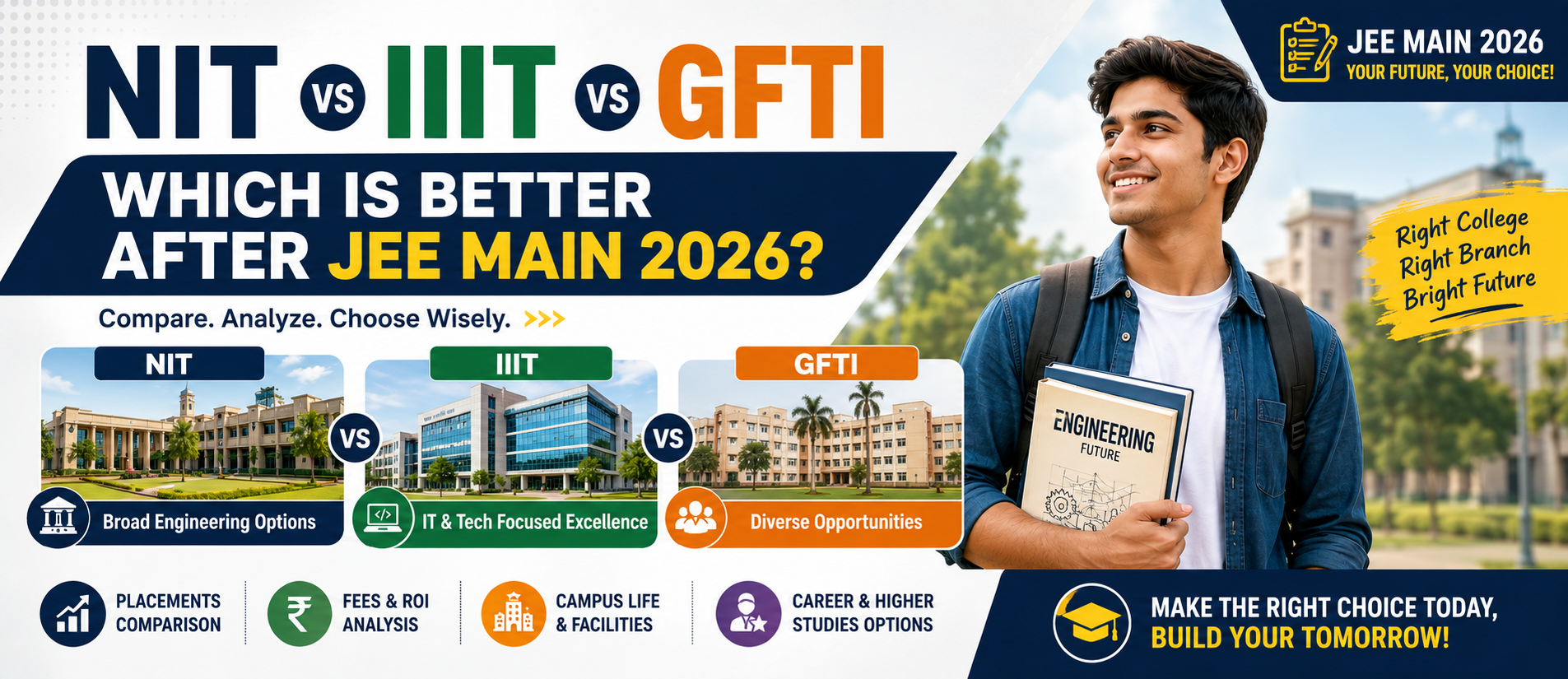
After JEE Main 2026, one of the biggest decisions for engineering aspirants is choosing between an NIT, IIIT or GFTI. All three categories include government-funded technical institutions, but their academic focus, branches, campus experience, fees, placement opportunities and admission cutoffs can be quite different.
For 2026-27 admissions, JoSAA is managing admissions to the NIT+ system, which includes 31 NITs, IIEST Shibpur, 26 IIITs and 56 Other-GFTIs.
So, is an NIT always better than an IIIT? Is an IIIT better for Computer Science? Are GFTIs worth considering?
The answer depends on your JEE Main rank, preferred branch, career goal, budget and willingness to relocate.
| Factor | NIT | IIIT | GFTI |
|---|---|---|---|
| Full Form | National Institute of Technology | Indian Institute of Information Technology | Government Funded Technical Institute |
| Main Focus | Engineering & technology | IT, CSE & related technology | Varies by institute |
| Branch Options | Usually wide | Often more focused | Depends on institute |
| Campus Life | Generally strong | Varies | Highly variable |
| CSE Opportunities | Excellent | Often excellent | Depends on college |
| Placements | Strong at top NITs | Strong at leading IIITs | Highly institute-dependent |
| Alumni Network | Generally strong | Strong in established IIITs | Varies |
| Best For | Broad engineering choices | CSE/IT/tech-focused careers | Students evaluating specific institutes |
Important: GFTI is a broad category rather than a single type of college. Therefore, you should evaluate the individual institute instead of assuming that every GFTI has the same academic or placement level.
National Institutes of Technology (NITs) are among India's prominent publicly funded engineering institutions. Admission to NITs for B.Tech programmes is primarily through JEE Main followed by JoSAA counselling.
There are 31 NITs included in the 2026 JoSAA system.
Some NITs have strong reputations across engineering disciplines, while others may be particularly attractive for specific branches.
For students who are not completely sure about their specialization, an NIT can be attractive because many NITs offer several engineering branches.
Indian Institutes of Information Technology (IIITs) are institutions with a strong emphasis on information technology, computer science and related fields.
JoSAA lists 26 IIITs in the 2026 admission system.
Many students interested specifically in Computer Science Engineering, Information Technology, Artificial Intelligence, Data Science and related areas consider IIITs seriously.
However, IIITs are not identical. Their academic programmes, infrastructure, campus size, fees and placement records can vary significantly.
GFTI stands for Government Funded Technical Institute.
This category covers a wide range of government-funded technical institutions participating in the JoSAA system. In 2026, JoSAA lists 56 Other-GFTIs.
The biggest point to remember is:
Do not judge a GFTI only by the GFTI label. Evaluate the individual college, branch and placement record.
A particular GFTI may be a very good choice for a specific course, location or career objective.
If your primary goal is Computer Science Engineering, the comparison becomes more complicated.
A strong IIIT with a technology-focused curriculum can be a better choice than a lower-preference NIT branch for a student who is strongly interested in software development.
For example, a student might need to decide between:
Good IIIT + CSE
vs.
Lower-demand branch + NIT
In such a situation, consider:
Therefore, college name alone should not determine your choice.
Placement is one of the most important factors for engineering students.
Top NITs generally have a strong mix of recruiters from software, core engineering, consulting, finance and other sectors.
Leading IIITs can be particularly attractive for students targeting:
Placement performance varies considerably from one GFTI to another.
Therefore, students should check the latest official placement report of the specific institute, rather than relying only on the GFTI category.
Don't look only at the highest package.
Check:
Fees should also be considered carefully.
A college with a higher fee is not necessarily a bad choice if it provides substantially better academic and career opportunities.
Calculate:
ROI = Career/earning potential ÷ Total education cost
Before accepting a seat, calculate the approximate four-year cost, including:
Also consider scholarships and applicable fee waivers.
Campus experience can be very different.
NITs generally offer relatively large campuses, multiple departments, student clubs, sports and cultural activities.
Many IIITs have a more technology-focused environment. Students may spend considerable time on coding, projects, research and technical activities.
Campus life varies significantly depending on the institute.
If campus life is important to you, check:
Consider: Strong IIITs and top NITs with CSE/IT-related branches.
Consider: NITs with strong departments in Mechanical, Electrical, Civil, Chemical, Electronics and other relevant disciplines.
Consider: Institutes offering strong AI, CSE, Data Science or related programmes, but carefully compare curriculum and faculty.
The institute category itself does not guarantee success in government examinations. Choose a college where you can maintain a good academic record while preparing for your target examination.
Look for institutes with:
Follow these seven steps:
Your rank is the starting point for understanding your realistic options.
Create separate lists for:
Don't compare only college names.
Compare:
College + Branch
For example, CSE at one institute may be more suitable for you than Mechanical Engineering at another.
Use official JoSAA opening and closing ranks when evaluating previous allocation trends. JoSAA provides the 2026 Opening and Closing Ranks through its official portal.
Remember that previous cutoffs are indicators, not guarantees for future allotment.
Look beyond the highest package and examine the complete placement picture.
Compare tuition, hostel, mess and other expenses.
Finally ask:
“Which college and branch will help me achieve my specific career goal?”
That is more useful than simply asking which category is “best.”
There is no single winner for every JEE Main 2026 student.
For JEE Main 2026 aspirants, the right choice is not simply NIT vs IIIT vs GFTI. The better question is:
Which college + branch + career opportunity gives me the best overall value?
A top NIT can be an excellent choice, but a strong IIIT may be better for a student focused on software and technology. Similarly, a particular GFTI can be worth considering if its branch, placements, fees and academic environment match your requirements.
Before finalising your JoSAA preference list, check the official 2026 opening/closing ranks, seat matrix, participating institutes and institute-specific eligibility rules. JoSAA provides these resources for the 2026 counselling process.
Confused between NIT, IIIT, GFTI or private engineering colleges after JEE Main 2026?
Admission Advisor can help you compare colleges, branches, fees, placements and admission opportunities based on your JEE Main rank.
CSE Vs AI/ML Vs Data Science Vs IT: Which B.Tech Branch Is Best In 2026?
23 August, 2026 By: AdmissionB.Tech Fees In India 2026: Government Vs Private Engineering Colleges
23 August, 2026 By: AdmissionBest Engineering Colleges Without JEE Main 2026: Complete Admission Guide
22 August, 2026 By: AdmissionWhich B.Tech Branch Is Best In 2026?
22 August, 2026 By: AdmissionWhat Is AdmissionAdvisor.in?
22 August, 2026 By: AdmissionCSE Vs AI/ML Vs Data Science Vs IT: Which B.Tech Branch Is Better In 2026?
21 August, 2026 By: AdmissionCollege Ranking Vs Placement: Which Matters More For Students?
19 August, 2026 By: AdmissionHow To Verify Whether A College’s Placement Claims Are Genuine
19 August, 2026 By: AdmissionHow To Score 95+ Percentile In JEE Main
18 August, 2026 By: AdmissionBest MBA Colleges In Delhi NCR 2026
17 August, 2026 By: AdmissionTop Colleges With Highest Placement Packages In India 2026
17 August, 2026 By: AdmissionAjay Kumar Garg Engineering College (AKGEC) Ghaziabad
17 August, 2026 By: AdmissionSDGI Global University Ghaziabad
16 August, 2026 By: AdmissionTop Private Engineering Colleges In India 2026
16 August, 2026 By: AdmissionCAT 2026 Preparation Strategy For Beginners: Complete Step-by-Step Guide
16 August, 2026 By: Admission